Category: Field Notes

  • Meet the SCR-Lite

    Meet the SCR-Lite

    Meet the SCR-Lite — short for Spectral Correlation Recorder. It’s a handheld investigation recorder we built here at the Paranormal Department. It watches several kinds of sensors at once, puts them all on one touchscreen, and saves everything so you can review your night later.
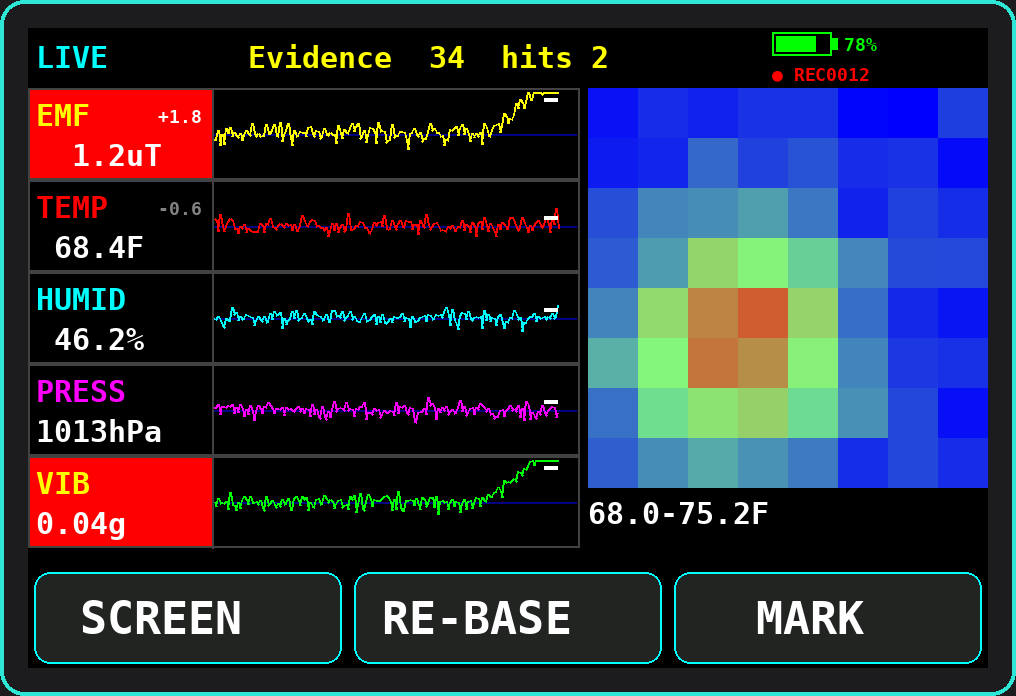
    SCR-Lite LIVE screen with five sensor lanes and an 8x8 thermal heat map
    The LIVE screen (illustration).

    The SCR-Lite is a hobby build we’re sharing just for fun — it is not for sale.

    The big idea: correlation

    Most single-sensor gadgets react to anything: a phone buzzes, the needle jumps. The SCR-Lite is built around correlation. It pays the most attention when two or more different sensors change at the same moment. That helps you tell an interesting moment apart from an everyday blip.

    What it senses

    • EMF — a magnetometer measures the magnetic field around the device.
    • Temperature, humidity and pressure — how warm, damp and “heavy” the air is.
    • Motion / vibration — how much the device is being moved or shaken.
    • Thermal camera — an 8×8 heat map that shows warm and cold areas in view.

    What it does

    • 3.5" touch screen with five screens: LIVE, THERMAL, YES/NO, MARKS and SESSIONS.
    • Evidence score (0–100) that only rises when two or more sensors agree — a built-in false-alarm filter.
    • AUTO-MARK saves a moment by itself when sensors spike together.
    • COLD SPOT alert when the coldest spot in the thermal view suddenly drops a few degrees.
    • Mood light — a small status light that shows calm, moderate or high activity at a glance, without spoiling dark-adapted eyes.
    • Sessions and evidence reports — every run is recorded automatically and gets a summary report you can download to a computer.
    • Rechargeable 1200 mAh battery with USB-C charging.

    Built to be simple in the dark

    Wake it, hold still for a ten-second baseline sweep, and it starts recording on its own. Tap MARK whenever something happens — a sound, a feeling, a question asked — and the exact moment (with every sensor reading) is saved. When you’re done, hold the screen for five seconds and it saves your session and goes to sleep.

    Read the manual

    The full user manual is a free download on the Manuals page.

    Entertainment purposes only: the SCR-Lite measures ordinary physical things. It can’t detect or prove ghosts, and readings can be caused by pets, drafts, electronics and plenty of everyday things. Always look for the normal explanation first.
  • How to Hunt for Cold Spots (EMF, Thermal & Temperature Basics)

    How to Hunt for Cold Spots (EMF, Thermal & Temperature Basics)

    Cold spots are one of the most famous ghost-hunting clues: a patch of air that is suddenly, noticeably chillier than the room around it. They’re also one of the easiest things to measure — which makes them a great place to start. Here are the basics of hunting cold spots with EMF, thermal and temperature readings, and how to stay honest about what you find.

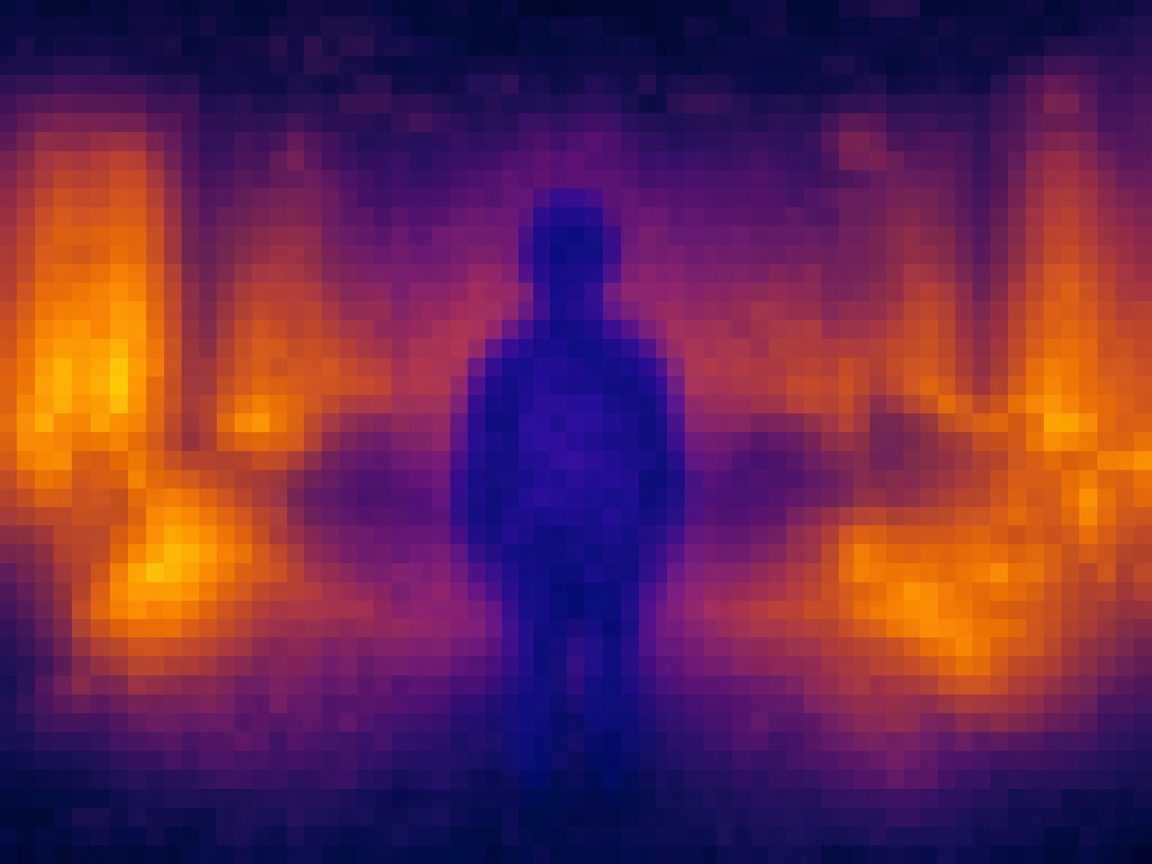
    Heat-map style image with a cold human-shaped spot
    A heat-map style illustration of a cold spot (AI-generated).

    Step 1: Take a baseline first

    Before you can call anything unusual, you need to know what “normal” looks like in that room. Set your gear down, stand still, and record the starting temperature, humidity and EMF for a minute or two. Every change you see later is measured against that baseline. If you move to a new room, take a new baseline.

    Step 2: Know your three tools

    Air temperature

    A temperature sensor tells you how warm the air is at the sensor. Watch for a quick drop of several degrees. Slow drifts over many minutes are usually just the house, the weather or the heating cycling on and off.

    Thermal camera

    A thermal camera shows surface temperatures as colors, so you can see cool and warm areas instead of guessing. Even a tiny 8×8 thermal sensor will show people, pets, lamps, vents and cold windows clearly. Sweep slowly and watch the coldest spot in view — a sudden drop of a few degrees there is worth marking.

    EMF (magnetic field)

    An EMF or magnetometer sensor measures the magnetic field around it. Wiring, appliances, phones, speakers, magnets and even metal furniture change it. That’s why EMF alone is a noisy clue — but when EMF and temperature change together, it’s much more interesting.

    Step 3: Look for two things at once

    One sensor misbehaving is almost always boring. Real “huh?” moments are when two or more different readings change at the same time — say, a sudden cold drop plus a jump in EMF. This idea, called correlation, is the core of how our SCR-Lite recorder decides when to auto-mark a moment.

    Step 4: Hunt the boring explanations first

    Almost every cold spot has a normal cause. Before getting excited, check:

    • Open or leaky doors and windows, fireplaces and chimneys
    • Air-conditioning or heating vents, ducts and fans
    • Cold glass, outside walls, basements and crawlspaces
    • You — your own body heat and movement change what the sensors see
    • Pets, other people, phones, lamps and electronics
    • Turning your device toward a cooler surface, or moving it at all

    Step 5: Mark it, repeat it, record it

    When something happens, note the exact time and what the readings were. Then try to repeat it: set the device down, leave it alone, and see whether the cold spot returns. If you film, say “mark” out loud when you note a moment so you can line it up with your video later. A spot that can be repeated is a mystery; one that vanishes the moment you close a door is a draft.

    Quick checklist

    1. Take a baseline in each new room.
    2. Hold still and sweep slowly.
    3. Watch for two sensors changing together.
    4. Rule out drafts, vents, windows and people.
    5. Mark the time, repeat the test, keep your notes.

    Reminder: this is a hobby for fun. Temperature, thermal and EMF readings can’t prove anything paranormal — but they can make a night in a dark old house a lot more interesting. Stay safe and never trespass.

  • Welcome to the Paranormal Department

    Welcome to the Paranormal Department

    Welcome to the Paranormal Department — part investigation team, part workshop, part campfire. If you’ve ever heard a floorboard creak in an empty room and wondered, “what was that?”, you’re in the right place.

    A lone mansion on a foggy hill at night
    AI-generated mood art.

    What we’re about

    We make spooky short videos, collect haunted photos, and write up what we learn in the field. We also build our own investigation gear from scratch — the kind of gadgets that put a handful of sensors on one screen so you can see what the room is doing while you’re standing in it.

    Our motto is simple: Investigate. Record. Share.

    • Investigate — go look, with curiosity and skepticism.
    • Record — write it down, mark the moment, keep the data.
    • Share — tell the story, good or bad, spooky or boringly explained.

    What you’ll find on the site

    Head to Videos for night investigations and jump scares, Photos for fog, shadows and strange shapes, and Articles for how-tos and field notes. Our home-built gear and its manuals live on the Gear and Manuals pages.

    Your stories wanted

    This isn’t a one-way street. If you’ve got a story, a photo or a video you can’t explain, send it through Share Your Story. Every submission is read by a real person before anything goes public, so you can send it in without worrying.

    A promise (and a disclaimer)

    We’re here for fun and for the thrill of the unknown. Nothing on this site is proof of the paranormal, and our devices are not scientific instruments. We’ll always tell you when something has a boring explanation — because spotting those is half the skill. And please, never trespass or enter unsafe buildings to chase a good story. No ghost is worth it.

    Grab a flashlight, turn the lights down low, and welcome in. Let’s see what’s out there.
