Other mysteryHeard: a voice on each recording, words unclear · Where: Union Cemetery, ZIP code 16422 (Harmonsburg, PA area) · Recorded: dates not known · Submitted by: Paranormal Department
Status: Unverified. We do not know what made these sounds, and we are not claiming they are paranormal. Recorded by Paranormal Department.
About the pin: placed at the middle of the ZIP code area only, not at the cemetery gate, a street or anyone’s home. All 16 recordings share this one pin.
Sixteen short recordings were made at Union Cemetery in the 16422 ZIP code area of Pennsylvania, and a voice can be heard on each one. The words can’t be made out. Each clip has its own player below, so press play and listen for yourself. Headphones help. The clips run from a few seconds to under twenty seconds each.
We have no transcripts and we are not going to guess at the words. What people hear in clips like these varies, and your brain is very good at finding speech in noise. If you hear something specific, tell us in a verification note below, and say which clip, what you think it is and why.
What we know and what we don’t
Place: Union Cemetery, ZIP code 16422. We are not giving a street address, and the map pin is only at the middle of the ZIP code area.
Date: recording dates not known. Recorded by Paranormal Department; posted October 2026.
The files: we do not know what processing, if any, was applied to the clips before they were posted. For this web copy we only raised the volume slightly. Nothing was filtered, cleaned up or enhanced.
Ordinary explanations still to rule out: wind, distant people or traffic, a radio or phone, an animal, microphone or recorder noise, and audio processing.
For entertainment and curiosity only. A recording is a claim, not proof of anything. Please respect Union Cemetery and any cemetery: do not visit after hours, do not disturb graves or private property, and never trespass to get a recording.
📍 See these recordings on the map. Were you there, or can you explain any of them? Add a verification note below — notes are read by a person before they appear.
A bright light in the sky that does not move like an airplane is a classic start to a UFO story. It is also, far more often than not, something ordinary seen in an unusual way. Here are seven common culprits — and how to check each one before you decide you have found a mystery.
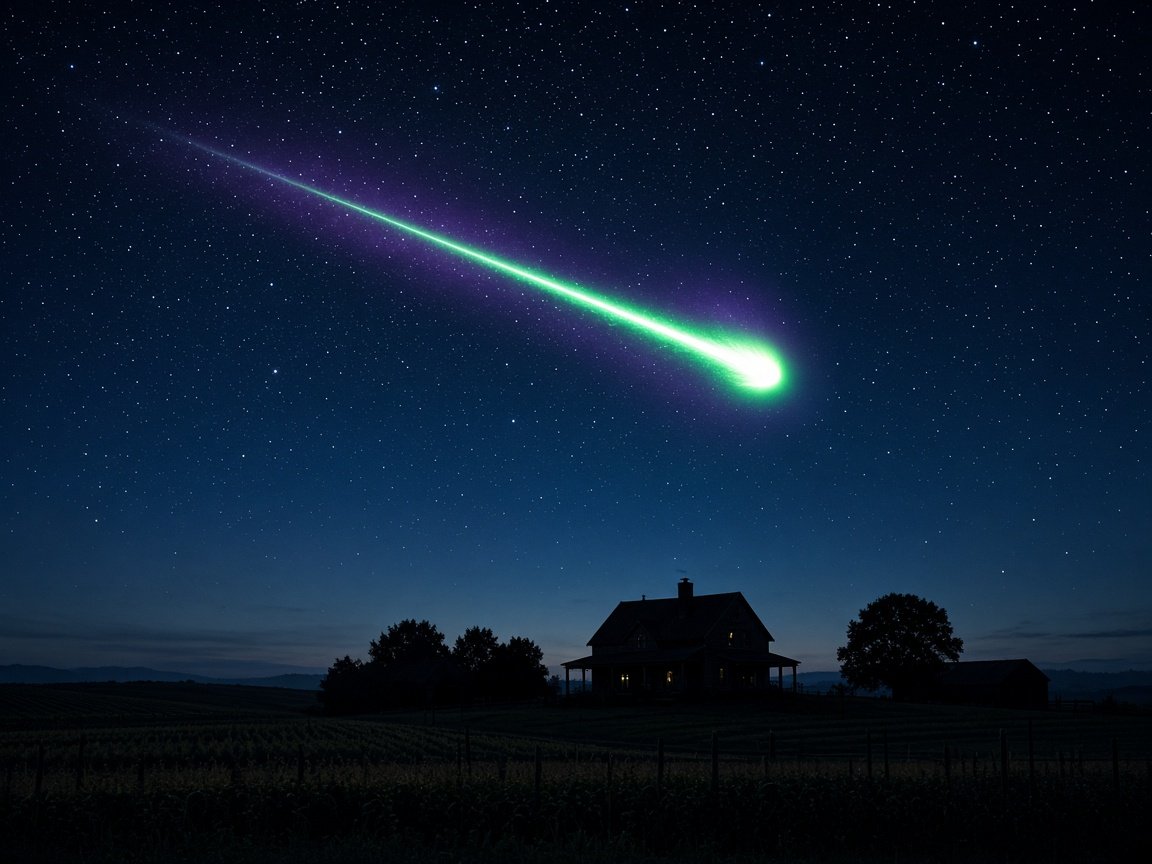
Fireballs can look dramatic and last only seconds. (AI-generated illustration.)
1. Venus and the other bright planets
Venus is the brightest planet in our sky and, shortly after sunset or before sunrise, can outshine every star. Low on the horizon it can twinkle and flash with color, and it seems to follow you when you drive because it is so far away. Jupiter and Mars can fool people too. Check: a free sky app such as Stellarium Web will show exactly where the planets are at your time and place.
2. The International Space Station and other satellites
The space station looks like a very bright, steady star gliding smoothly across the sky for a few minutes, with no blinking lights. Many other satellites appear as faint, steady dots moving at a constant speed. Check: NASA’s Spot the Station and Heavens-Above list passes for your location.
3. Starlink “trains”
Shortly after a batch of Starlink satellites is launched, they travel in a line and can appear as a string of evenly spaced lights crossing the sky, then slowly spread out over the following days. It is an impressive sight — and a very common source of “formation of lights” reports. Check: satellite trackers show recent launches and pass times.
4. Meteors and fireballs
Most meteors last a second or two. A fireball is a particularly bright meteor; it can be dramatic, sometimes breaks into pieces, and may be seen across a wide area. Check: the American Meteor Society collects fireball reports, so you can see whether others saw the same thing at the same time.
5. Aircraft
A plane flying toward you can look like a single bright, nearly stationary light, because you are seeing its landing lights head-on. Sound arrives late, so a high jet may seem silent. Sunlit contrails can glow orange or pink at dusk. Check: a flight-tracking app can show whether an aircraft was in that part of the sky.
6. Balloons, sky lanterns and drones
Weather balloons are released daily by weather services, party balloons and sky lanterns can drift for miles, and drones with bright lights are increasingly common — including coordinated light shows. Balloons drift with the wind rather than flying a controlled path. Check: note the wind direction and whether the object moved with it.
7. Clouds, reflections and camera effects
Lenticular clouds are smooth, lens-shaped clouds that can look like stacked saucers. Reflections in windows, lens flares and long-exposure smears can also turn into “objects” on photos and video. Check: does the shape move when you move the camera? Does it appear in other shots, or only through glass?
How to document a sighting well
Write down the date, time, your location and the weather right away.
Note the direction (a compass app helps) and the height — a fist held at arm’s length is roughly 10° of sky.
Estimate how long it lasted and describe how it moved: steady, wobbling, blinking, fading.
Film a wide shot that includes the horizon or landmarks, not just a zoomed-in dot.
Compare against sky and satellite apps before you share it.
Most reports do turn out to have ordinary explanations — but “most” is not “all,” and carefully recorded cases are the ones worth studying. If you have one, we’d love to see it: share a sighting.
This article is for entertainment and general interest and is not a substitute for official or scientific sources.
If you ask what the U.S. government has actually concluded about UFOs, the best place to start is a long, unglamorous Air Force program called Project Blue Book. Its numbers are worth knowing — and so is what they do and don’t mean. This is a short, plain-English summary of the documented record.
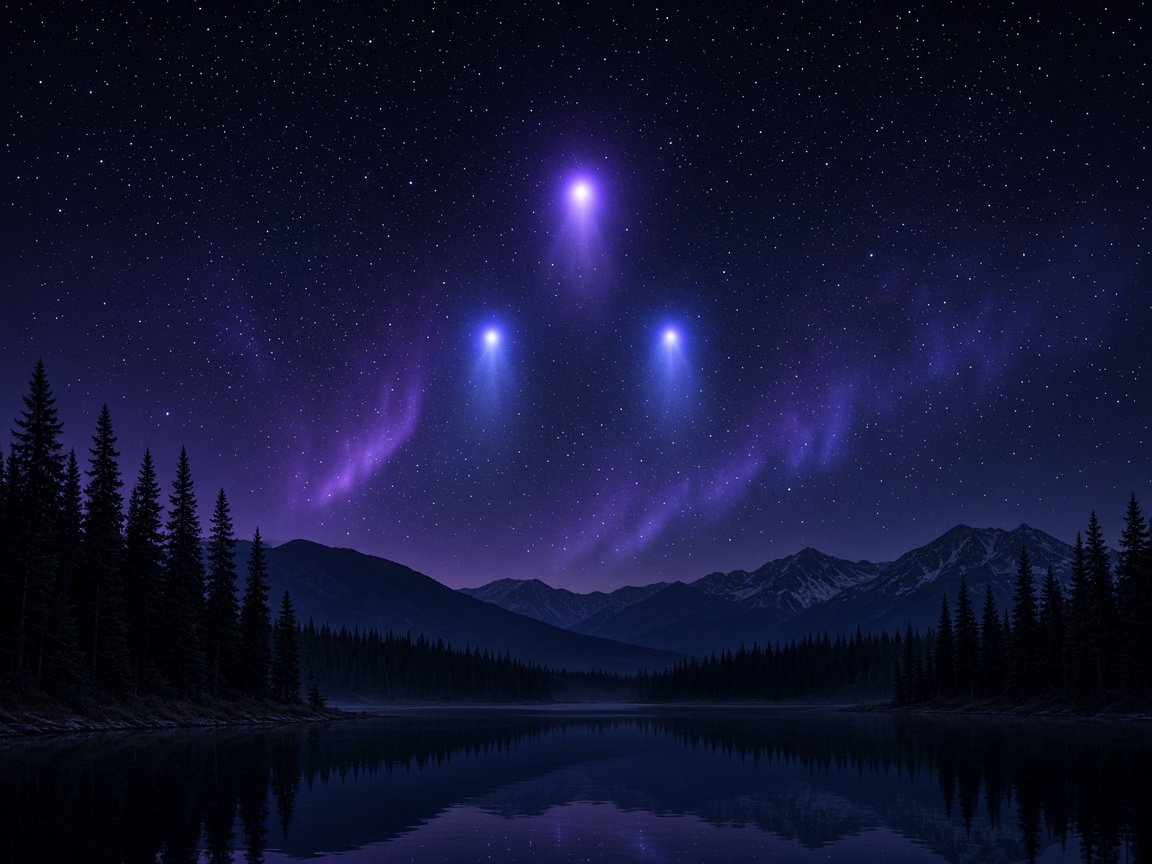
Unexplained lights in the night sky have been reported for as long as people have looked up. (AI-generated illustration.)
What was Project Blue Book?
Project Blue Book was the U.S. Air Force program for investigating unidentified flying objects. According to the U.S. National Archives, from 1947 to 1969 a total of 12,618 sightings were reported to the project, which was headquartered at Wright-Patterson Air Force Base in Ohio. The Air Force announced its termination on December 17, 1969, and its records were later declassified and placed in the custody of the National Archives.
What does “unidentified” mean?
Of those 12,618 reports, the National Archives says 701 remain “unidentified.” That word is easy to misread. In the Air Force’s usage it simply meant the investigators could not match the report to a known cause with the information they had — often a thin report, a single witness, or no measurements at all. It does not mean “extraterrestrial,” and it does not mean “proven impossible to explain.” It means “we don’t know,” which is a perfectly good starting point for curiosity.
Most of the other reports were attributed to ordinary things: astronomical objects such as bright planets and meteors, aircraft, balloons and similar. That pattern is the main reason skeptics urge people to check the ordinary explanations first (see Seven Everyday Things Mistaken for UFOs).
The scientist in the middle
The program’s long-time scientific consultant was J. Allen Hynek, an astronomer. He began as a skeptic and, over the years, argued that a small number of well-documented cases deserved more serious scientific attention. He is also remembered for a way of classifying encounters — “close encounters of the first, second and third kind” — that later became part of popular culture.
What did outside scientists conclude?
In the late 1960s the Air Force asked the University of Colorado to review the subject independently. The resulting study, known as the Condon Report after its director, physicist Edward Condon, concluded in 1968 that UFO research in the preceding two decades had not added to scientific knowledge, and that further extensive study of UFO reports was unlikely to advance science. Critics of the report disagreed, and the debate about it has never fully gone away — but it was a major reason the Air Force closed Blue Book.
A modern footnote
The topic came back into public view with the term “UAP” (unidentified anomalous phenomena). In June 2021 the Office of the Director of National Intelligence released a preliminary assessment of 144 U.S. government reports of unidentified aerial phenomena from 2004 to 2021. It said that only one could be identified with high confidence — a large, deflating balloon — and that the rest remained unexplained, largely because there was not enough good data. The report did not conclude that any of them were extraterrestrial.
Why it still matters
Blue Book is a useful lesson in how to think about the sky: most reports have mundane answers, a small remainder lack enough information to say, and “we can’t explain it yet” is not the same as “we know what it was.” Good records — time, place, direction, duration, photos and video taken carefully — are what turn a mystery into something that can actually be investigated.
Want to read the source? The U.S. National Archives hosts information about Project Blue Book at archives.gov/research/military/air-force/ufos, and the ODNI preliminary assessment is available from the Office of the Director of National Intelligence.
Seen something yourself? Share a sighting — and tell us what you ruled out. This article is for entertainment and general interest; it summarizes public records and is not a substitute for them.
Meet the SCR-Lite — short for Spectral Correlation Recorder. It’s a handheld investigation recorder we built here at the Paranormal Department. It watches several kinds of sensors at once, puts them all on one touchscreen, and saves everything so you can review your night later.
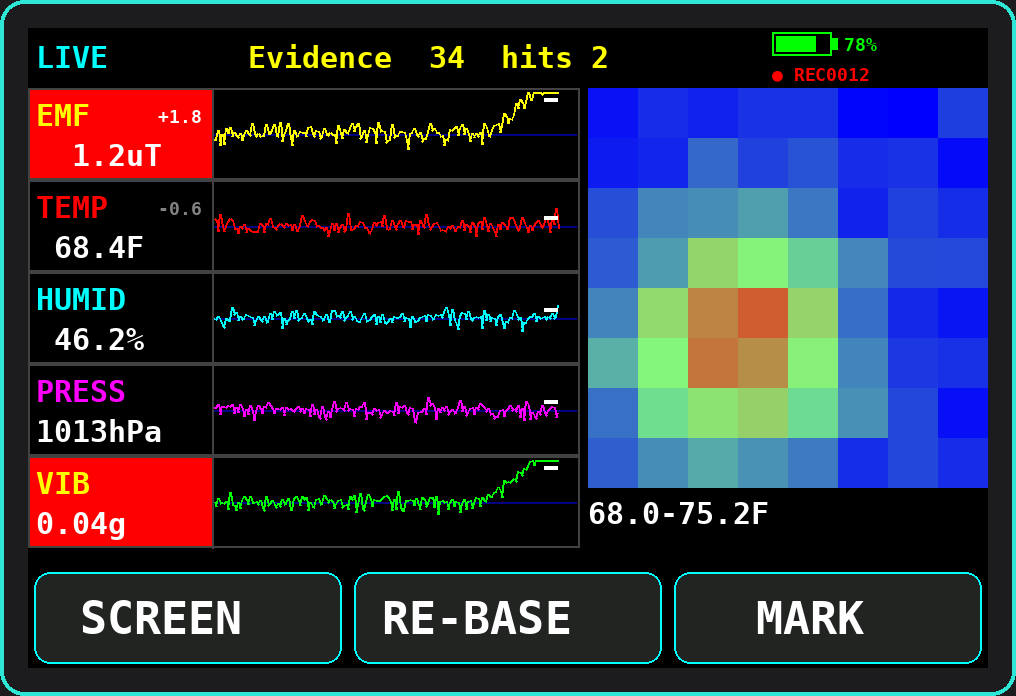
The LIVE screen (illustration).
The SCR-Lite is a hobby build we’re sharing just for fun — it is not for sale.
The big idea: correlation
Most single-sensor gadgets react to anything: a phone buzzes, the needle jumps. The SCR-Lite is built around correlation. It pays the most attention when two or more different sensors change at the same moment. That helps you tell an interesting moment apart from an everyday blip.
What it senses
EMF — a magnetometer measures the magnetic field around the device.
Temperature, humidity and pressure — how warm, damp and “heavy” the air is.
Motion / vibration — how much the device is being moved or shaken.
Thermal camera — an 8×8 heat map that shows warm and cold areas in view.
What it does
3.5" touch screen with five screens: LIVE, THERMAL, YES/NO, MARKS and SESSIONS.
Evidence score (0–100) that only rises when two or more sensors agree — a built-in false-alarm filter.
AUTO-MARK saves a moment by itself when sensors spike together.
COLD SPOT alert when the coldest spot in the thermal view suddenly drops a few degrees.
Mood light — a small status light that shows calm, moderate or high activity at a glance, without spoiling dark-adapted eyes.
Sessions and evidence reports — every run is recorded automatically and gets a summary report you can download to a computer.
Rechargeable 1200 mAh battery with USB-C charging.
Built to be simple in the dark
Wake it, hold still for a ten-second baseline sweep, and it starts recording on its own. Tap MARK whenever something happens — a sound, a feeling, a question asked — and the exact moment (with every sensor reading) is saved. When you’re done, hold the screen for five seconds and it saves your session and goes to sleep.
Read the manual
The full user manual is a free download on the Manuals page.
Entertainment purposes only: the SCR-Lite measures ordinary physical things. It can’t detect or prove ghosts, and readings can be caused by pets, drafts, electronics and plenty of everyday things. Always look for the normal explanation first.
Cold spots are one of the most famous ghost-hunting clues: a patch of air that is suddenly, noticeably chillier than the room around it. They’re also one of the easiest things to measure — which makes them a great place to start. Here are the basics of hunting cold spots with EMF, thermal and temperature readings, and how to stay honest about what you find.
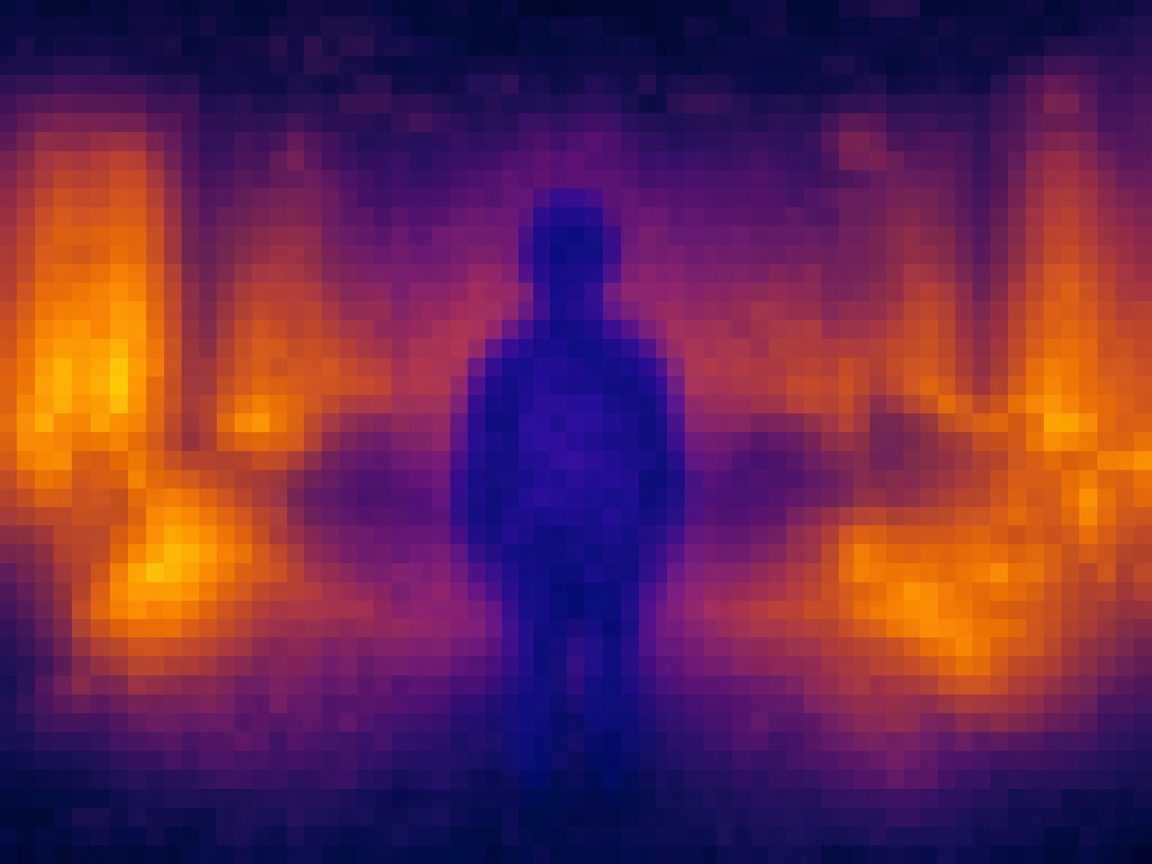
A heat-map style illustration of a cold spot (AI-generated).
Step 1: Take a baseline first
Before you can call anything unusual, you need to know what “normal” looks like in that room. Set your gear down, stand still, and record the starting temperature, humidity and EMF for a minute or two. Every change you see later is measured against that baseline. If you move to a new room, take a new baseline.
Step 2: Know your three tools
Air temperature
A temperature sensor tells you how warm the air is at the sensor. Watch for a quick drop of several degrees. Slow drifts over many minutes are usually just the house, the weather or the heating cycling on and off.
Thermal camera
A thermal camera shows surface temperatures as colors, so you can see cool and warm areas instead of guessing. Even a tiny 8×8 thermal sensor will show people, pets, lamps, vents and cold windows clearly. Sweep slowly and watch the coldest spot in view — a sudden drop of a few degrees there is worth marking.
EMF (magnetic field)
An EMF or magnetometer sensor measures the magnetic field around it. Wiring, appliances, phones, speakers, magnets and even metal furniture change it. That’s why EMF alone is a noisy clue — but when EMF and temperature change together, it’s much more interesting.
Step 3: Look for two things at once
One sensor misbehaving is almost always boring. Real “huh?” moments are when two or more different readings change at the same time — say, a sudden cold drop plus a jump in EMF. This idea, called correlation, is the core of how our SCR-Lite recorder decides when to auto-mark a moment.
Step 4: Hunt the boring explanations first
Almost every cold spot has a normal cause. Before getting excited, check:
Open or leaky doors and windows, fireplaces and chimneys
Air-conditioning or heating vents, ducts and fans
Cold glass, outside walls, basements and crawlspaces
You — your own body heat and movement change what the sensors see
Pets, other people, phones, lamps and electronics
Turning your device toward a cooler surface, or moving it at all
Step 5: Mark it, repeat it, record it
When something happens, note the exact time and what the readings were. Then try to repeat it: set the device down, leave it alone, and see whether the cold spot returns. If you film, say “mark” out loud when you note a moment so you can line it up with your video later. A spot that can be repeated is a mystery; one that vanishes the moment you close a door is a draft.
Quick checklist
Take a baseline in each new room.
Hold still and sweep slowly.
Watch for two sensors changing together.
Rule out drafts, vents, windows and people.
Mark the time, repeat the test, keep your notes.
Reminder: this is a hobby for fun. Temperature, thermal and EMF readings can’t prove anything paranormal — but they can make a night in a dark old house a lot more interesting. Stay safe and never trespass.
Welcome to the Paranormal Department — part investigation team, part workshop, part campfire. If you’ve ever heard a floorboard creak in an empty room and wondered, “what was that?”, you’re in the right place.
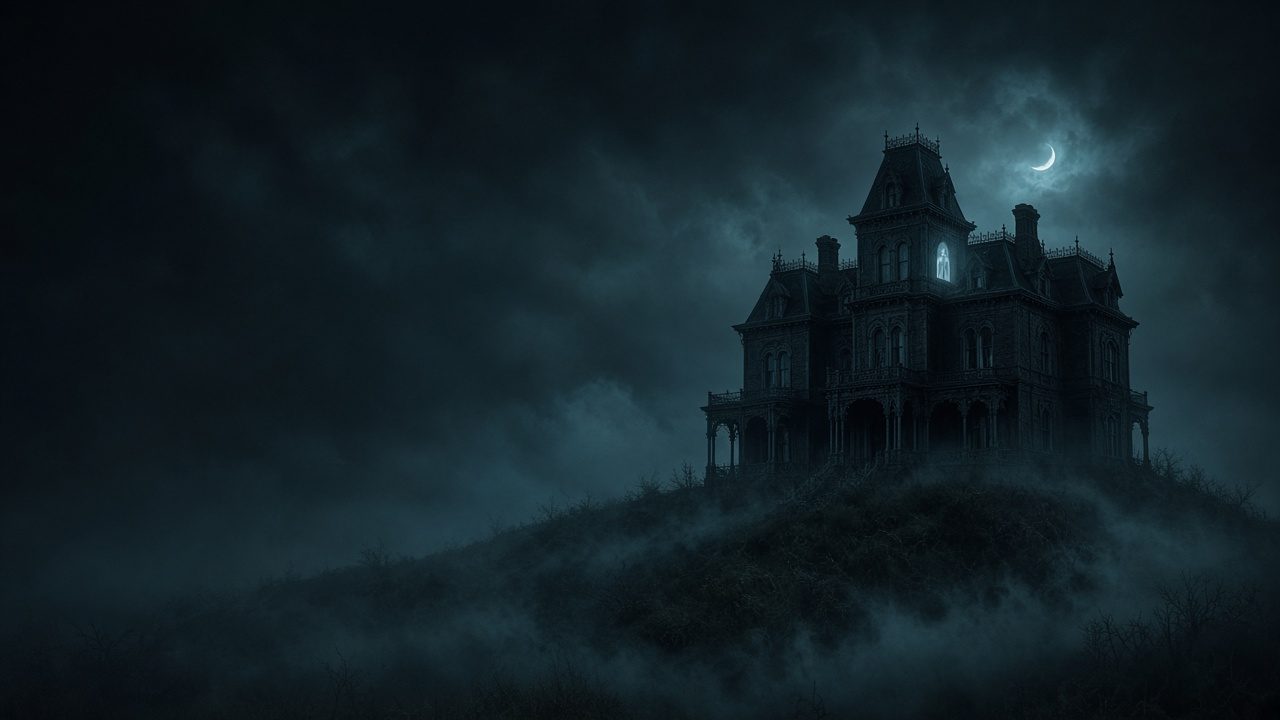
AI-generated mood art.
What we’re about
We make spooky short videos, collect haunted photos, and write up what we learn in the field. We also build our own investigation gear from scratch — the kind of gadgets that put a handful of sensors on one screen so you can see what the room is doing while you’re standing in it.
Our motto is simple: Investigate. Record. Share.
Investigate — go look, with curiosity and skepticism.
Record — write it down, mark the moment, keep the data.
Share — tell the story, good or bad, spooky or boringly explained.
What you’ll find on the site
Head to Videos for night investigations and jump scares, Photos for fog, shadows and strange shapes, and Articles for how-tos and field notes. Our home-built gear and its manuals live on the Gear and Manuals pages.
Your stories wanted
This isn’t a one-way street. If you’ve got a story, a photo or a video you can’t explain, send it through Share Your Story. Every submission is read by a real person before anything goes public, so you can send it in without worrying.
A promise (and a disclaimer)
We’re here for fun and for the thrill of the unknown. Nothing on this site is proof of the paranormal, and our devices are not scientific instruments. We’ll always tell you when something has a boring explanation — because spotting those is half the skill. And please, never trespass or enter unsafe buildings to chase a good story. No ghost is worth it.
Grab a flashlight, turn the lights down low, and welcome in. Let’s see what’s out there.