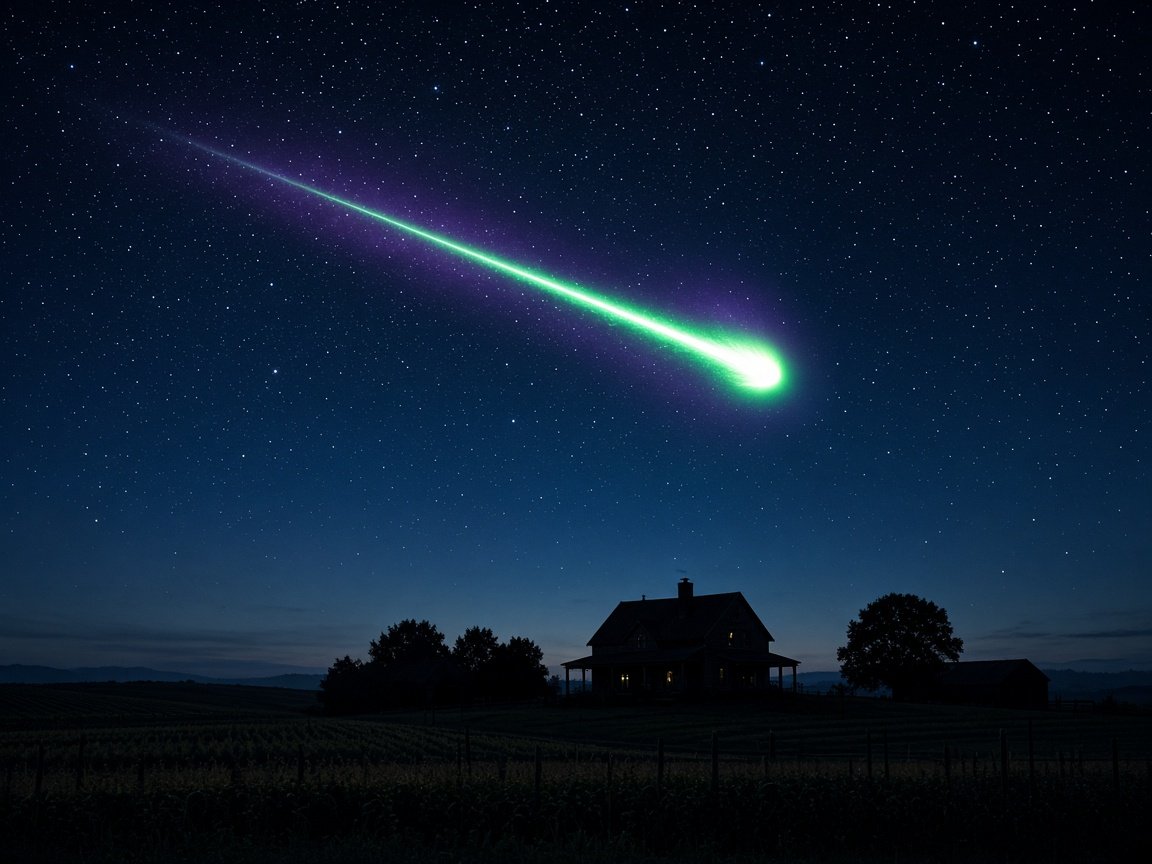
A bright light in the sky that does not move like an airplane is a classic start to a UFO story. It is also, far more often than not, something ordinary seen in an unusual way. Here are seven common culprits — and how to check each one before you decide you have found a mystery.

1. Venus and the other bright planets
Venus is the brightest planet in our sky and, shortly after sunset or before sunrise, can outshine every star. Low on the horizon it can twinkle and flash with color, and it seems to follow you when you drive because it is so far away. Jupiter and Mars can fool people too. Check: a free sky app such as Stellarium Web will show exactly where the planets are at your time and place.
2. The International Space Station and other satellites
The space station looks like a very bright, steady star gliding smoothly across the sky for a few minutes, with no blinking lights. Many other satellites appear as faint, steady dots moving at a constant speed. Check: NASA’s Spot the Station and Heavens-Above list passes for your location.
3. Starlink “trains”
Shortly after a batch of Starlink satellites is launched, they travel in a line and can appear as a string of evenly spaced lights crossing the sky, then slowly spread out over the following days. It is an impressive sight — and a very common source of “formation of lights” reports. Check: satellite trackers show recent launches and pass times.
4. Meteors and fireballs
Most meteors last a second or two. A fireball is a particularly bright meteor; it can be dramatic, sometimes breaks into pieces, and may be seen across a wide area. Check: the American Meteor Society collects fireball reports, so you can see whether others saw the same thing at the same time.
5. Aircraft
A plane flying toward you can look like a single bright, nearly stationary light, because you are seeing its landing lights head-on. Sound arrives late, so a high jet may seem silent. Sunlit contrails can glow orange or pink at dusk. Check: a flight-tracking app can show whether an aircraft was in that part of the sky.
6. Balloons, sky lanterns and drones
Weather balloons are released daily by weather services, party balloons and sky lanterns can drift for miles, and drones with bright lights are increasingly common — including coordinated light shows. Balloons drift with the wind rather than flying a controlled path. Check: note the wind direction and whether the object moved with it.
7. Clouds, reflections and camera effects
Lenticular clouds are smooth, lens-shaped clouds that can look like stacked saucers. Reflections in windows, lens flares and long-exposure smears can also turn into “objects” on photos and video. Check: does the shape move when you move the camera? Does it appear in other shots, or only through glass?
How to document a sighting well
- Write down the date, time, your location and the weather right away.
- Note the direction (a compass app helps) and the height — a fist held at arm’s length is roughly 10° of sky.
- Estimate how long it lasted and describe how it moved: steady, wobbling, blinking, fading.
- Film a wide shot that includes the horizon or landmarks, not just a zoomed-in dot.
- Compare against sky and satellite apps before you share it.
Most reports do turn out to have ordinary explanations — but “most” is not “all,” and carefully recorded cases are the ones worth studying. If you have one, we’d love to see it: share a sighting.
This article is for entertainment and general interest and is not a substitute for official or scientific sources.