Status: Explained (in part) — an investigator concluded the crew likely saw the planets Jupiter and Mars, plus radar clutter. This is disputed.
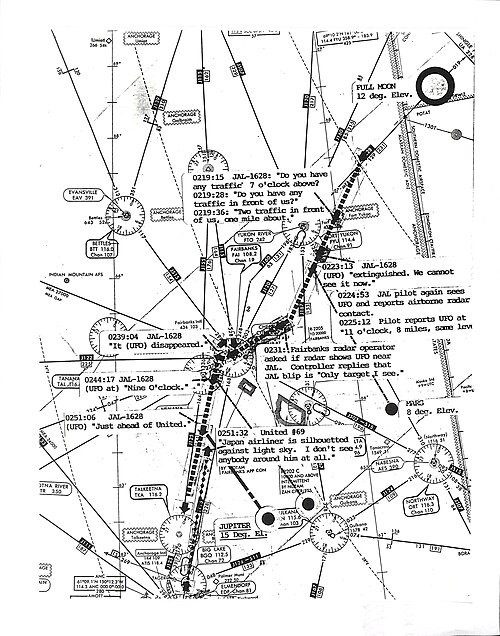
Credit: U.S. Federal Aviation Administration / U.S. National Archives (1986) · Licence: Public domain (per Wikimedia Commons) · Source
Japan Air Lines Cargo Flight 1628 was a Boeing 747-200 flying from Paris Charles de Gaulle to Narita. On the Reykjavík to Anchorage leg, at 5:11 p.m. on November 17, 1986, over eastern Alaska, pilot Kenji Terauchi reported seeing three unidentified objects at 35,000 feet. Media reports quoted him calling them “two small ships and the mothership.”
After about six minutes he radioed the FAA in Anchorage, which saw the objects on its radar and advised him to take evasive action. Terauchi descended and circled, but said the lights stayed with the plane for about 400 miles, moving quickly and stopping suddenly. At the time, news reports said the FAA saw objects near the plane even after his maneuvers.
On later review, military radar images were dismissed as clutter, and an object seen on the FAA's screens was judged a split image of the aircraft. Fairbanks controllers saw only the 747. A United Airlines flight and a U.S. Air Force C-130 nearby reported seeing nothing, visually or on radar. FAA investigators found the crew to be professional and rational. Editor Philip Klass said that Jupiter and Mars were in the area where the two lights appeared. Some astronomers agree, though the pilot and others have rejected the explanation.
Sources: Wikipedia: Japan Air Lines Cargo Flight 1628
📍 See this case on the map. Were you nearby, or can you explain it? Add a verification note below — notes are read by a person before they appear.
Leave a Reply